The Three Big Things That Determine Your Final Bill
Before we dive into numbers, understand this: dental implant costs aren't just one price. They're a stack of services, materials, and expertise that add up in different ways for different people.
Think of it like building a house. The final price depends on the land (your jawbone), the foundation work needed (grafting), the materials you choose (titanium vs. zirconia), and who's doing the building (general dentist vs. specialist).
1. The Basics: What Every Implant Needs
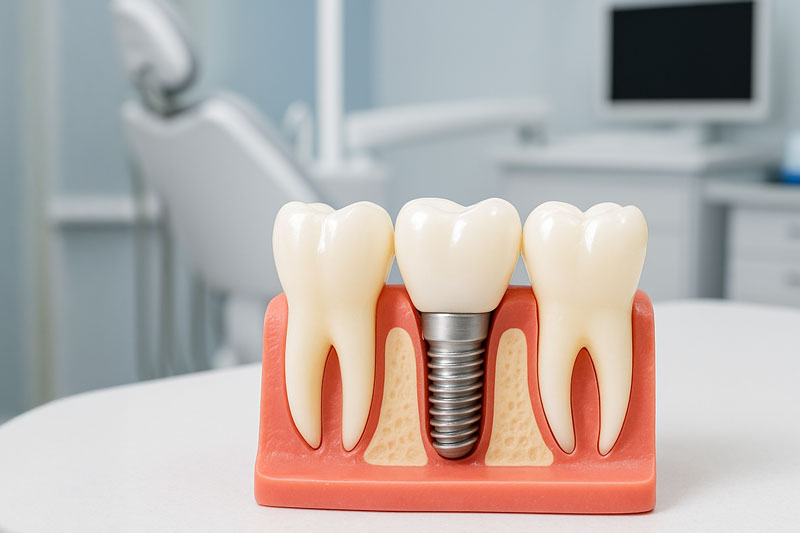
A standard single-tooth implant breaks down into three main pieces:
-
The implant itself (the titanium post that goes into your jawbone) — think of this as the foundation
-
The abutment (the connector piece that sits above the gum) — the structural support
-
The crown (the part that looks like a tooth) — the finished, visible result
For a straightforward case—meaning you have healthy bone, no extractions needed, no complications—you're typically looking at something in the $3,000 to $7,000 range for that single tooth.
But here's where it gets interesting: that's just the starting point.
2. The Variables: When Things Get More Complicated
Most people don't have "textbook" mouths. And that's where additional costs come in.
Bone Grafting: Building a Strong Foundation
If your jawbone has shrunk since you lost the tooth (common, because bone needs stimulation from teeth to maintain itself), you might need a graft. Think of it like adding soil before you plant.
Bone grafting typically runs $500 to $3,000 per site, depending on where the grafting material comes from—your own body, a donor, or synthetic materials. The more complex the graft, the higher the cost.
Sinus Lifts: Creating Space Upstairs
For upper back teeth, sometimes the sinus cavity sits too low where the implant needs to go. A sinus lift gently moves the sinus up and adds bone underneath. This procedure typically adds $1,500 to $4,000 to your treatment plan.
Extractions and Socket Preservation
If the damaged tooth is still there, removing it isn't always simple. A basic extraction might cost a couple hundred dollars. A surgical extraction of a tricky tooth? More. And if your dentist wants to preserve the socket (the hole) to keep bone volume intact for later, that's an additional procedure with its own fee.
Gum Grafting
Sometimes the issue isn't bone—it's gum tissue. If you need more gum volume for health or appearance reasons, soft-tissue grafting adds another layer of surgical fees.
Here's the takeaway: two people getting "a single implant" could have final bills that differ by thousands of dollars, and both might be perfectly reasonable given their individual situations.
Location, Location, Location: Where You Live Matters
You probably already know that everything costs more in certain cities. Dental implants are no exception.
| Region | Typical Single-Implant Range |
|---|---|
| Major coastal cities (NYC, LA, San Francisco, Boston) | $4,000 – $7,500 |
| Suburban and mid-sized cities | $3,000 – $6,000 |
| Smaller towns and rural areas | $2,500 – $5,000 |
These are ballpark figures for a straightforward implant with crown, no major extras.
Why the Difference?
It's not that dentists in big cities are greedier. Their overhead is just fundamentally different:
-
Rent for a Manhattan office versus rural Kansas? Not even close.
-
Staff salaries reflect local cost of living.
-
Malpractice insurance varies dramatically by region.
-
Equipment costs are the same everywhere, but they eat up a different percentage of revenue depending on patient volume.
The University Option
Here's a insider tip: dental schools and university-affiliated clinics often offer significantly lower fees. You're being treated by supervised students or residents, which means procedures take longer, but the oversight is thorough and the cost reduction can be substantial. If you're near a major university with a dental school, it's worth a consultation.
Material Choices: Titanium, Zirconia, and the Quest for "Natural Looking"
Remember when dental work was obvious? Those days are mostly gone. Modern materials are remarkable, but they come at different price points.
Titanium: The Workhorse
Titanium implants have been the gold standard for decades. They're incredibly strong, predictably integrate with bone, and have decades of research behind them. They're also generally the more affordable option.
Zirconia: The Aesthetic Alternative
Zirconia is a ceramic material that's gained popularity, especially for patients who prefer metal-free restorations or have specific aesthetic concerns. The implant body itself is white, which eliminates any potential gray show-through if gums are thin.
The trade-off? Zirconia systems often cost more—sometimes significantly—and the long-term track record, while promising, isn't as deep as titanium's.
The Crown Itself
That visible part—the part everyone actually sees—can be made from different materials too:
-
Porcelain fused to metal: Traditional, strong, more affordable
-
All-ceramic or zirconia: More natural light transmission, better aesthetics, higher cost (often $1,500 to $3,000 for the crown alone)
If the implant is in a visible front tooth, most people opt for the higher-end materials because, well, you look at yourself in the mirror every day.
Technology: The Cool Stuff That Costs Extra
Modern dentistry has access to tools that would have seemed like science fiction a generation ago. They improve outcomes, but they also add to the bill.
3D Imaging (CBCT)
Instead of flat X-rays, many implant dentists now use cone-beam CT scans that create a 3D model of your jaw. They can see nerve positions, bone density, sinus locations—everything. This is often a separate fee, typically several hundred dollars.
Surgical Guides
Using that 3D scan, some dentists create a custom surgical guide—a template that fits over your teeth and shows exactly where to place the implant. It's like GPS for your mouth. This precision adds cost (often several hundred to a few thousand dollars) but can reduce surgical guesswork significantly.
Digital Impressions
Remember the goopy impression material that made you gag? Many offices have replaced it with digital scanners. Faster, more comfortable, and often more accurate—but the equipment is expensive, and that cost gets reflected somewhere.
Real-World Scenarios: What Different Cases Actually Look Like
Let's make this concrete with three hypothetical patients. These are approximate ranges, but they reflect how costs stack up.
Sarah: The Straightforward Case
-
Situation: Lost a lower molar years ago, but maintained good bone through diligent hygiene. No current infection, healthy gums.
-
Needed: Single implant, standard abutment, ceramic crown.
-
Estimated range: $3,000 – $5,000
-
Timeline: Implant placement, wait 3-4 months for healing/bone integration, then crown placement. Done.
Marcus: The "I Should Have Done This Sooner" Case
-
Situation: Lost an upper premolar. Waited a while. Bone has resorbed (shrunk) moderately. Needs grafting before implant.
-
Needed: Bone graft + healing period (4-6 months), then implant placement, then crown.
-
Estimated range: $4,000 – $8,000
-
Timeline: Graft, wait, implant, wait, crown. About 9-12 months total.
Diane: The Complex Posterior Case
-
Situation: Missing an upper back molar. Sinus is low, bone is minimal. Tooth was recently extracted, site needs preservation.
-
Needed: Extraction + socket preservation, sinus lift with grafting, healing, implant placement, custom abutment, high-quality crown.
-
Estimated range: $6,000 – $12,000+
-
Timeline: Extraction/graft, wait, sinus lift/graft, wait, implant, wait, crown. Potentially over a year.
Notice the pattern: Same goal—replace one missing tooth—but wildly different paths to get there. And all three are completely normal scenarios.
The Multiple-Teeth Question
Everything above focuses on a single implant. If you need multiple teeth replaced, the math changes.
Multiple Individual Implants
Three missing teeth? Three implants. The per-implant cost might drop slightly because of efficiencies, but you're essentially multiplying the surgical and restorative fees.
Implant-Supported Bridges
For multiple missing teeth in a row, sometimes fewer implants can support a bridge (like a row of replacement teeth attached to two or three implants). This can reduce the number of surgical sites while still restoring function.
Full-Arch Rehabilitation
If you're missing all teeth in an arch (upper or lower), options like "All-on-4" or similar techniques use strategically placed implants to support a full fixed bridge. These are major reconstructions—think tens of thousands of dollars—but they transform people's lives and facial structure in ways individual implants can't match.
How to Get a Real Estimate (And Not Be Blindsided)
Here's the practical part. When you're sitting in that consultation, here's exactly what to ask for:
Request a Written, Itemized Treatment Plan
Don't accept a vague "about five to seven thousand" estimate. Ask for a breakdown that lists:
-
Diagnostic fees: Exam, X-rays, 3D scans
-
Surgical fees: Implant placement, any grafting, extractions
-
Restorative fees: Abutment, crown, any temporary teeth during healing
-
Laboratory fees: What the lab charges for creating your custom pieces
-
Follow-up visits: What's included after the work is done
Questions Worth Asking
-
"Is this the total cost from start to finish, or are there potential additional fees if things don't go exactly as planned?"
-
"What materials are included at this price? Are there upgrade options I should consider?"
-
"What happens if the implant doesn't integrate successfully? Is there a warranty or replacement policy?"
-
"Do you offer payment plans, or work with healthcare financing companies?"
-
"Can you explain the timeline and when each payment is due?"
The Second Opinion Rule
For any major dental work—and implants definitely qualify—a second opinion isn't just reasonable, it's smart. Different dentists may have different approaches to the same clinical situation. One might recommend grafting where another thinks it's unnecessary. One might use premium materials as standard where another offers choices.
Comparing two detailed treatment plans can be incredibly educational. Just be upfront that you're gathering information; good clinicians understand and respect that.
Insurance: The Fine Print
Here's the honest truth about dental insurance and implants: most plans weren't designed for this.
Traditional dental insurance evolved in an era when missing teeth were usually replaced with bridges or dentures. Implants were rare. Many plans still cap annual benefits at $1,500 to $2,000—which, as you can see, doesn't go far.
That said, there are variations:
-
Some newer plans specifically include implant coverage, often at 50% of the cost up to a certain limit
-
Many plans will cover associated procedures (extractions, exams, X-rays) even if they don't cover the implant itself
-
Some cover the crown portion even if they exclude the surgical part
-
A few offer "implant riders" you can purchase for additional premium
The golden rule: Read your plan documents carefully, and don't assume anything. Ask your insurance company directly: "What is my coverage specifically for dental implants and all related procedures?" Get it in writing if possible.
Value vs. Price: The Long Game
Here's the thing about implants that's easy to forget when you're staring at a big number: they're designed to last.
A well-placed, well-maintained implant can function for decades. Compare that to other options:
-
A traditional bridge might last 10-15 years, then need replacement (with new costs)
-
Removable partial dentures have ongoing maintenance, replacement, and the hassle factor
-
Doing nothing leads to bone loss, shifting teeth, and eventually more complex problems
When you spread the implant cost over 20 or 30 years, it often becomes the most economical choice—even with the higher upfront investment.
Red Flags vs. Reasonable Savings
Not everyone charging less is cutting corners. Some practices run efficient operations, have lower overhead, and pass savings to patients. That's legitimate.
But if a quote seems dramatically lower than others, ask why. Legitimate reasons might include:
-
Limited use of advanced technology (no 3D scans, surgical guides)
-
Use of stock components rather than custom
-
A practice model focused on high volume
Less legitimate reasons might include:
-
Skipping essential diagnostic steps
-
Using lower-quality components
-
Not including follow-up care in the quote
The safest approach: understand what you're getting, not just the bottom line.
Your Takeaway: A Practical Summary
Dental implant costs aren't one number—they're a conversation. That conversation should include:
-
Your specific clinical needs: Bone quality, adjacent teeth health, sinus location, gum condition
-
Your geographic reality: Costs vary by region, and that's okay
-
Your material preferences: Titanium or zirconia? Standard or premium crown?
-
Your timeline: Can you phase treatment, or do you need everything done quickly?
-
Your financial situation: What payment options exist, and what does insurance actually cover?
The typical single-tooth implant in the US falls somewhere in the $3,000 to $7,000 range for straightforward cases. Add complexity, and you're looking at $4,000 to $12,000+.
Yes, that's a wide range. But now you know why.
The Bottom Line
Missing teeth affect more than just your smile—they affect how you eat, speak, and feel about yourself. Implants are the closest thing we have to replicating natural teeth, and for most people, they're worth the investment.
The key is going in with open eyes. Ask questions. Get itemized estimates. Understand what you're paying for and why. And remember: the cheapest option isn't always the best value, and the most expensive isn't always necessary.
Your mouth is unique. Your treatment plan should be too.
Have more questions about dental implants? The best first step is always a consultation with a qualified dental professional who can look at your specific situation. Bring this guide with you—and don't be shy about asking for the details.